
History
Our Past, Our History, Our Roots
In the early 1900s, several German, Catholic families settled in the community of Mt. Vernon, Kansas. Many of these families attended mass at either St. Joseph in Ost or St. Louis in Waterloo. In 1910, Bishop John J. Hennesy, the first Bishop of the Diocese of Wichita, was in search of land for a new church in Mount Vernon because, at the time, it was claimed Catholics were not welcome in the town of Cheney. Mount Vernon was the next closest town making it an ideal place to start a new parish. In 1911, the current parish property was acquired by Bishop Hennesy, and shortly after, the first church began to be erected. Construction of the new church began under Fr. George Schneider, who was the Pastor of both St. Rose of Lima in Mt. Vernon and St. Louis in Waterloo. Fr. Schneider was transferred, and Fr. Bernard Garmann was assigned to both parishes. While he was pastor, construction of the first church was completed. The first church cost approximately $8,500.00 to build. St. Rose was dedicated on October 28, 1911, by Bishop John J. Hennesy.
During those days, the Pastor lived at the rectory at St. Louis in Waterloo, and members of the two parishes would take turns bringing him between the parishes. At the time, no Saturday Vigil Mass was permitted, so masses for the two parishes were at 8 a.m. and 10 a.m. The masses alternated between the two parishes.
In 1915, Rev. B. Garmann purchased the Methodist Church in Mt. Vernon and about two acres of land for $700.00. The church building was remodeled and used for the first parochial Catholic school for St. Rose. In the same year, Fr. B. Garmann purchased what was known as "Modern Woodmen Hall" in Mt. Vernon, which was converted into a convent for the Sisters of the Precious Blood who taught at the school from 1915 to 1918. In 1918, the school was closed and the students attended Mt. Vernon public schools.
On June 24, 1920, the pride of the parish, the first Church of St. Rose Mt. Vernon was struck by lightning and destroyed. Sadly, insurance would not cover the cost to rebuild the church, but at the encouragement of Bishop John J. Hennesy, Fr. Garmann labored with the parish and succeeded in building the second church. This church proudly stood for 100 years and served the parish well. It is believed the second church was built on the same foundation of the first church. The second church was build for $12,000.00 and was dedicated on the patronal feast day of the parish, August 30, 1921, by Bishop A. J. Schwertner. The dedication of this church was this Bishop's very first church dedication.
In 1921, the Sisters of the Sorrowful Mother came to Mt. Vernon, reopened, and took charge of the Parish school. The school building was enlarged at the time to accommodate the increased number of students.
In 1936, the school had grown to 63 students and the sisters continued to grow under the leadership of Fr. B. Garmann and the Sisters of the Sorrowful Mother. In the same year, one of the parishioners donated two acres of land, which became the cemetery.
In 1942, the parish bought the hall located across the street, known as "Mt. Vernon Hall" for around $750 from a group of parishioners who owned it. In the same year, the entire Church facilities were wired for electricity, and the lights were reportedly used for the first time on the Feast of the Immaculate Conception.
In 1947, the interior of the Church was remodeled. At that time, a large amount of plaster had to be removed, the entire church was painted, and the new plaster was applied at the cost of $1000. The statues were removed, the organ was moved down to the front part of the church, and the communion rails were taken out. A new wooden altar was constructed and placed in the sacristy facing the congregation. The hall was also remodeled, enlarged, and sided.
In 1949, the discussion began about building a new school. The school was built for $17,000, in which $4,500 had to be borrowed from the Diocese to finish the project. Most of the work was done through the generous stewardship of the people of the parish. The school still stands to this day.
In 1950, the Daughters of Isabella St. Rose of Lima Circle #832 was founded at St. Rose, Mt. Vernon. The Daughters are still around in various parishes around the diocese, but they have little connection with St. Rose of Lima Mt. Vernon at this time.
In 1957, the parish of St. Rose Mt. Vernon would change forever when the U.S. Congress authorized the construction of Cheney Dam and Reservoir. In early 1960, many family's farms and properties were claimed by the state to begin construction.
From 1962 to 1965, the dam was constructed. The construction of this reservoir relocated many members of the parish, and thus, the life of the parish began to take on a new form. Instead of primarily a farming community, St. Rose became a vacation parish for the many visitors who came to enjoy the park and lake. This continues to give St. Rose the unique opportunity to be true evangelizers and beacons of hospitality.
In 1963, the Sisters were recalled to their order. Fr. Harvey became the first resident priest and taught the upper grades. The Convent was converted into the Rectory and remained until it was torn down in 2020. After the 1963-1964 school year, the school was permanently closed. The building served as a social hall along with the "big" hall across the road. The classrooms were used for religious instructions by lay volunteers.
In 1979, Fr. John Reinkmeyer was appointed pastor. In the following year, new carpet, pews, and colored windows were installed in the church. The records indicate the Altar was restored to its original location, and a new one was built. A new communion rail was also installed. Gradually, the statues were repaired and placed back into the church.
In 1981, work began to demolish the old parish hall. Most of the work was done by members of the parish. The task was long and arduous and was not completed until the following spring.
In 1982, a new garage was built next to the rectory. The garage was built from wood of the old hall. In the same year, a wind storm "wreaked havoc" on many of the church buildings. Many of the buildings had to be repaired. It is believed this is the same time in which the steeple to the church was lowered because of damage.
In 1984, a new parish hall was build at the cost of $125,000. Money was borrowed from the diocese to complete the project which was paid off towards the end of 1985.
In 1986, the exterior of the second church was extensively repaired and vinyl siding and steel doors were installed at the cost of $10,700. St. Rose also joyfully celebrated the parish's 75th anniversary with a parade and other festivities.
In 1992, with the retirement of Msgr. Herbert Hertel, St. Rose and St. Louis welcomed St. Joseph, Ost to become a tri-parish family. At that point, the past of St. Rose resided at St. Joe. The three parishes worked and prayed as sister parishes for nearly 30 years.
Throughout the history of St. Rose, the parishioners have gone to great lengths to keep the parish maintained and running well. In 1997, the basement of the school was partitioned into classrooms to make more room for the students in the growing Parish School of Religion. In 2008, a state-of-the-art sound system was installed in the hall. The cemetery crucifix was reworked and reinstalled as the cemetery expanded. The following year, the church received the gift of new front doors, as well as minor foundation repair on the south side of the church.
In October 2011, St. Rose joyfully celebrated her centennial with a weekend of events for the parish and friends of the parish. There was a parade, dinner, dance, and fireworks. Fr. Ivan Eck was the pastor for this joyous event. Around this time, an audio/visual system was installed that allowed the Mass to be streamed to the hall to accommodate the overflow. It was becoming apparent that St. Rose parish was outgrowing her church.
In 2015, members of the parish established a building fund with the help of Pastor, Fr. Aaron Spexarth, to combat concerns regarding limited space and dilapidated buildings. Parishioners and friends of the parish continued over the years to put money in the Building Fund and many memorials were established at that time.
In 2017, a group from the St. Rose Men's Club approached Fr. Daniel Duling about looking at the overall needs of our infrastructure. He then formed a Steering Committee that would later develop into the Building Committee for St. Rose. Extensive studies were done on all the buildings, and it was determined the cost to repair and add on more seating would far outweigh the cost of building a new church. Many town halls and discussions were held with the overall greater parish community. While the decision was not easy, it was determined that the best course for the parish was to build a new church.
In roughly 2018, the building committee developed a Master Plan that would look at the next fifty years at the parish and her needs. The top two priorities became a new church and parish center for the Parish School of Religion, which currently serves over 120 students each week. A five-phase plan began to be implemented at that time.
On August 15, 2020, at the Feast of the Assumption, a groundbreaking ceremony was held by His Excellency, Carl A. Kemme, 11th Bishop of Wichita.
Our Present, Our Moment, Our Joy
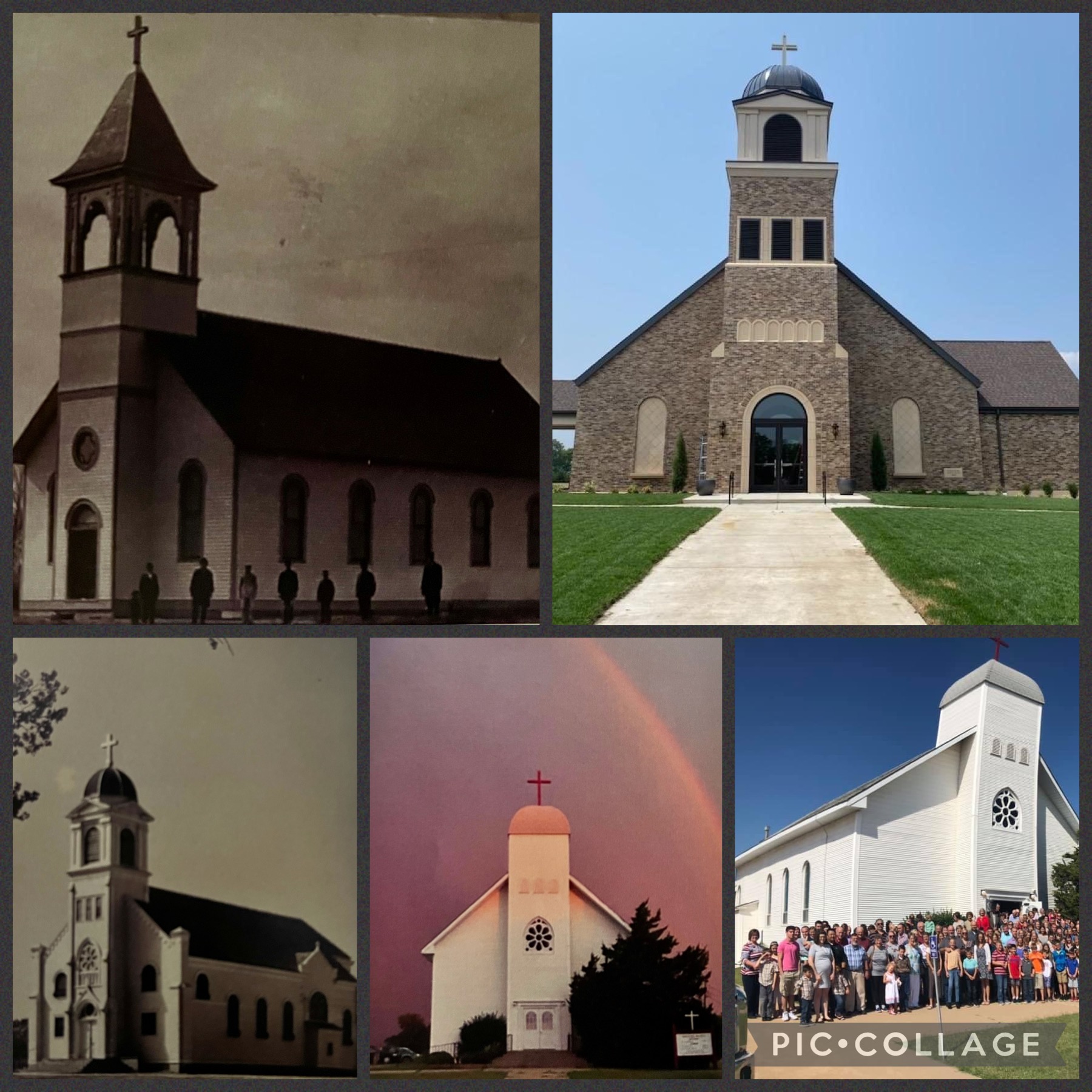
When the people of St. Rose decided to start building a new church, it was extremely important to pay honor to our past. To accomplish this, pictures inside and outside our past two churches were gathered to present to our architect for design.
The unique shape of the bell towers have dominated the structure of the two previous churches. This tradition continues as the new bell tower is a combination of the previous two churches. The bells are significant. They ring to call people to worship, they are a sign of where the church is located, and they train our eyes to look up to God. This is where our hearts and minds long to be when we enter the church. In our bell tower, we have two bells. One was the original bell that has now hung in all three churches. The second bell was donated by a good friend of the parish and by the youth of the parish.
Community is what is at the heart of the people of St. Rose. Previously, without a gathering space, people would congregate on the steps in front of the church. The new church now has a gathering space to encourage community, even in inclement weather. It will also allow for overflow seating for larger celebrations around the Eucharistic Table.
When walking into the church, the front immediately draws attention. The design of the arch above the High Altar is the same arch from the previous churches. The High Altar has been refurbished from the previous church. In the High Altar, which houses the tabernacle, is The Last Supper. This, too, was refurbished and painted in color. It is a stunning rendition. Also, housed in the High Altar, is our patroness, St. Rose. She draws us into the Eucharistic Feast depicted in this painting and housed in the tabernacle. The Altar was reconstructed to fit the new St. Rose of Lima statue.
On the right of her is St. Catherine of Siena. St. Rose of Lima modeled her Spiritual Life after St. Catherine, so she is a fitting edition as she stands holding her own heart in her hand. Catherine had loved Christ so much she had asked Jesus to take her heart as a sign of that love. Legend tells us, Jesus, in turn, gave her His heart. From then on, Catherine repeatedly spoke of being on fire with Christ's love. In her other hand is a book to symbolize St. Catherine being a doctor of the Church.
On the left of our beloved St. Rose of Lima is St. Dominic. She followed the rule of St. Dominic in her life and was a 3rd order Dominican as her father would not allow her to join the convent. St. Dominic is depicted with a dog with a torch in his mouth. St. Dominic's mother had a dream when she was pregnant with St. Dominic of a dog with a torch in its mouth, running around setting everything on fire. She immediately ran to the monastery to ask the monk what it meant. He replied that St. Dominic will set the world ablaze with the fire of his words. Indeed he has. He is also seen holding a lily, which is a symbol of chastity.
Our beloved St. Rose of Lima is the largest statue on the High Altar. She is holding a crucifix in an outward position, as if inviting one to take it. Her eyes are looking upward towards Jesus on the crucifix hanging above her. St. Rose of Lima had a powerful devotion to our crucified Christ because in it, she saw just how much Christ loved us. In her other hand, she holds a Bible because of her devotion to the scriptures. In other instances, St. Rose is depicted holding the child, Jesus. St. Rose also had a strong devotion to the Blessed Mother and often experienced ecstatic visions of Christ. She often prayed at an altar dedicated to the Virgin and Child. She is the first saint from the Americas, and we are blessed to have her as our Patron Saint. Today, we dedicate this church in her honor. At the beginning of this project, at the direction of Fr. Dan Duling, the people of the parish entrusted the entire project to her intercession, so it is fitting that she should hold a place of honor at the High Altar.
St. Rose's eyes are gazing upward towards the beautiful new crucifix as if to direct us towards Christ. This corpus is a life-size corpus of Jesus' death on the cross. Much discussion was had over whether or not to keep the bloody Christ or paint over his wounds. After studying more of St. Rose and her devotion for the crucified Christ, the decision was made to leave the wounds as a sign of what Jesus suffered for love of us. This crucifix is suspended above the High Altar as if it is floating, drawing minds and prayer upward. Above the crucifix is a Trinitarian rose window. The crucifixion opened the gates of heaven for us, and it is by his crucifixion we gain eternal life with Him in Heaven. Therefore, the crucifix leads us up to the Trinity.
In the rose window, God the Father is dressed in purple, the color of royalty. He holds an orb of the world as He created us and loves us. Jesus is depicted in red to symbolize His Passion and shedding of His precious blood on the cross. He is holding a cross out of love for us. Both are crowned as Kings of Heaven and Earth and are holding up their right hands, blessing His people.
Above them is the Holy Spirit, symbolized by a dove, with rays of Grace coming from Him, shedding out upon all. All three are depicted sitting on the clouds of Heaven, awaiting our arrival.
The statues of our Blessed Mother and St. Joseph, as well as the Altars, were taken out of the previous church, refurbished, and placed in our new Church.
To the right of the Altar is the Pieta, Mary holding Jesus' lifeless body. This status was in the previous church but was refurbished and placed in its current location. In Mary's eyes and face, the artist depicts the sorrow Mary felt in a stunning way.
The Station of the Cross you see hung throughout the Church were in the previous Church as well. At one time, they were taken down and were going to be discarded, but a member of the parish saved them from being destroyed. Later, they were repaired and hung back in the previous church. It is a blessing to have them repainted and now hanging in the new church. The windows will eventually be completed with stained glass of the Seven Sorrows of Mary. Currently, the Nativity is to the left of the Sanctuary, and the Burial of Jesus is to the right. The remaining six Sorrows of Mary will be added in time. St. Rose had a strong devotion to the Blessed Mother, so it is fitting these windows should grace St. Rose Church. In the cry room, a stained-glass window of Jesus with the children will be hung, and in the confessional will be a depiction of the Hemorrhaging Woman touching the hem of Jesus' garment at the beginning of her own conversion.
On August 13, 2021, the New Church was dedicated by His Excellency Carl A. Kemme, 11th Bishop of Wichita, at the invitation of Fr. Daniel J. Duling, pastor, and the people of the parish. A three-day celebration of thanksgiving took place in conjunction with the dedication.